Events More Information
PRINT
BACK
-
Publish Date:2026/09/04
Modify Date:2026/10/02
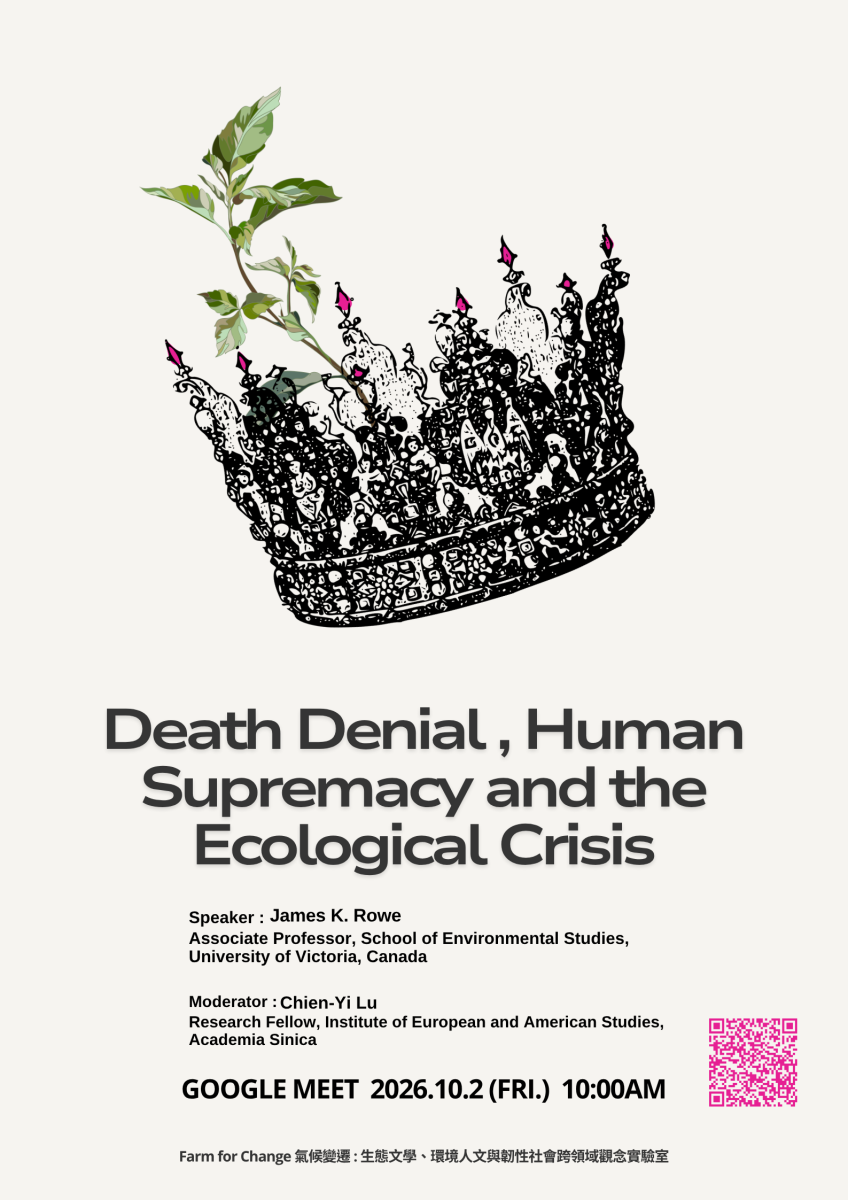
Death Denial, Human Supremacy and the Ecological Crisis
Time: 10:00 A.M.-12:00 P.M., Friday, October 2, 2026
Venue: Google Meet: https://meet.google.com/tkm-nvyz-wku
Speaker: Dr. James Rowe (Associate Professor, School of Environmental Studies, University of Victoria)
Chair: Dr. Chien-Yi Lu (Research Fellow, Institute of European and American Studies, Academia Sinica)
Organizer: Farm for Change, Institute of European and American Studies, Academia Sinica
Website: https://engfarmforchange.ea.sinica.edu.tw/academic-events
Contact: Pimei Lin, +886-2-3789-7222, pimei@as.edu.tw
Abstract:
I will introduce the work of anthropologist Ernest Becker, particularly his existential explanation for human supremacy. His argument that death denial shapes behavior, culture, and institutions inspired a subfield of social psychology known as terror management theory (TMT), which received considerable media attention in the COVID-19 era. And yet, beyond social psychology, his work has had limited uptake across the humanities and social sciences, even though his death-denial thesis bears on foundational questions of power and injustice. According to Becker and other TMT researchers, the intense existential fear caused by the reality of death compels humans to psychologically buffer themselves with cultural constructions of supremacy that compensate for the overwhelming helplessness they feel in the face of finitude. A key limitation of Becker’s argument, however, was his overreach: his claim that all cultures denied death, albeit in different ways. The final part of my book includes a case study of Coast Salish approaches to mortality, arguing that the nonsupremacist worldviews and ecological successes of Salish peoples are deeply connected to their different orientations toward death, especially when compared to Euro-American death denial. The Coast Salish case is one example among many of non-European societies who have developed mind–body practices to face the fact of finitude and avoid compensatory illusions of supremacy.